
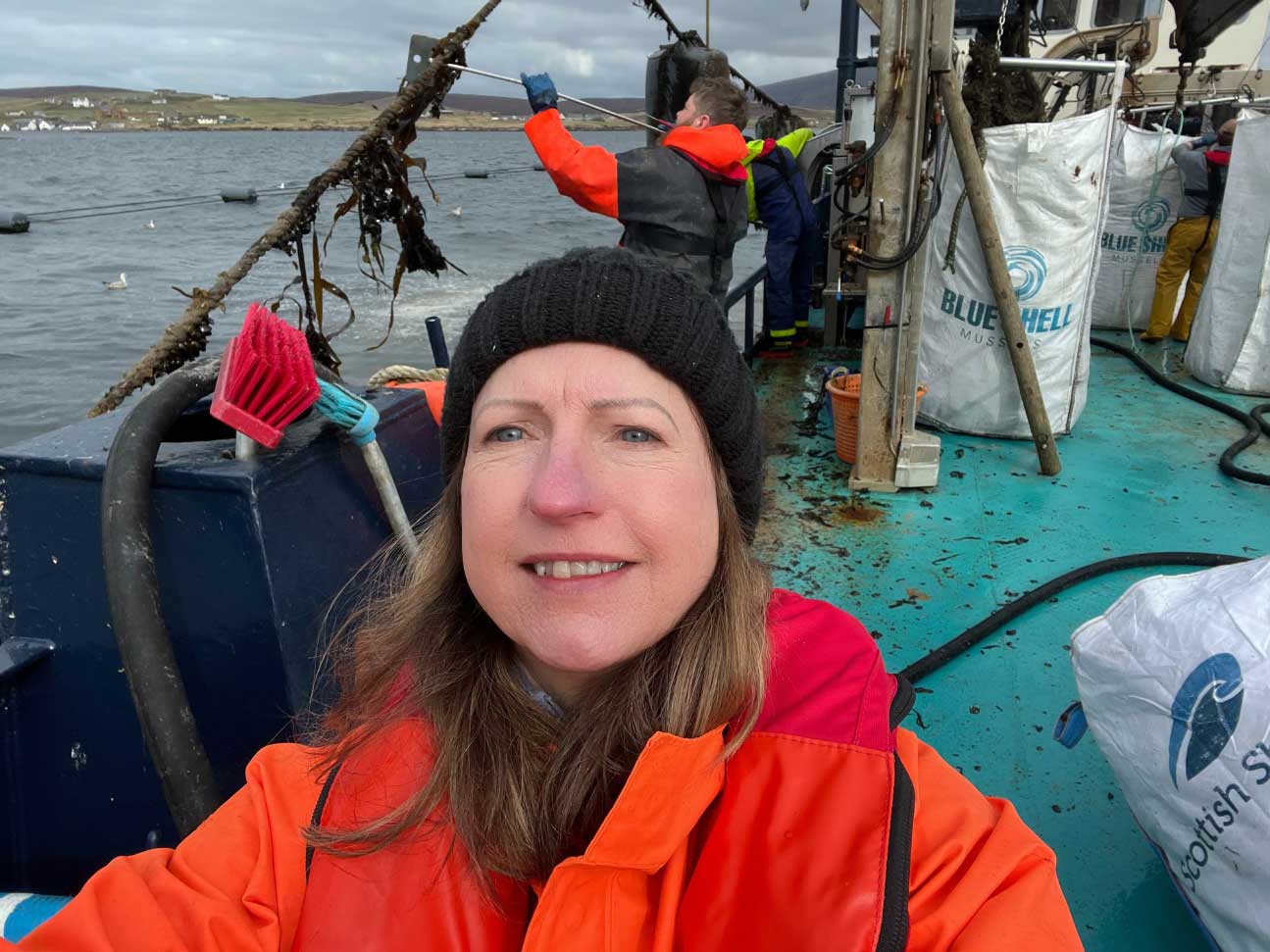
Hello, I’m Kelly, the Brand Ambassador for Scottish Farmed Shellfish, which basically covers Scottish Mussels and Scottish Oysters.
This year I’ve been busy learning about the industry and those that work in it. I like to completely throw myself in so I decided that I would volunteer for a shift on one of the mussel boats.
This coincided with a visit to the Shetlands to film a series of recipe videos and create some content about how mussels are farmed.
Now 6am starts are not usually my thing but there I was, bright and early with the rest of the crew, ready to head off on the silver shimmering waters near the harbor in Brae.
The boat was skippered by Sam Laurenson and with his crew we set off for the first mussel farm, about an hour away. Sitting up deck gave me an opportunity to talk to the guys about their experience as mussel farmers and what it’s been like living and working in the Shetlands.
What surprised me was how involved in the land and sea they were. Working 2 week shifts on the mussel boat and then helping on family Crofts during their 2 weeks off. They had an obvious connection with the food they produce and the graft that goes into it. This connection with the land and sea was also something that drew Sam back to the sea, after a brief stint studying at university.
It’s sad but true that many people have now lost their connection with the food they eat. From school children that think carrots are made in Asda, to a disassociation with livestock farming from adults that just don’t see a sausage as a pig, or a leg of lamb as that cute animal jumping about in farmers’ fields every spring.
This disassociation has more than likely contributed to the staggering amount of food waste, with the average household now wasting a third of the food they buy. Globally, food waste contributes 8-10% of total man-made greenhouse gas (GHG) emissions. If food waste were a country, it would be the world’s third largest emitter after China and the USA.
During my research of all things Mussels, I’ve been exploring the barriers to why some people never choose Scottish shell on mussels from a supermarket. Whilst the feedback is not properly backed up research (as sadly there is little around), the feedback that I have had is that there is a natural barrier, which is the shell!
Arriving at the first mussel farm we haul up the first set of ropes and start to clean off the mussels and other sea creatures from the ropes that hold the mussel ropes in place. The ropes are then cut (the best job!) and then the mussel ropes are pulled up a belt and mechanically stripped This still requires manual intervention as all the seaweed needs to be removed as it goes through the machine (otherwise it would clog up the machine). I quickly decided that this is the worst job on deck and actively avoid it!
The mussels that we are removing fall into the water and provide a great food source for wildlife below and above the water. None of which are bothered by the shell in the slightest.
At this farm location, we were thinning out or ‘resocking’ the juvenile mussels. They’re removed from the ropes so that they can be given more room to grow bigger on another rope, sometimes in a different location. What fascinated me was that you can see the line on the mussels where it’s been removed and relocated, so on each shell you can see how many times it’s been ‘resocked’, like a footprint of its journey to your plate.
Given this disconnection from the food we eat, the industry has a real challenge, or opportunity, to inspire a new generation of consumers.
The world’s population is set to increase by 2 billion by 2050 and to feed this increase will mean a 60% increase in food production, requiring a land area twice the size of India. Therefore, not using land to produce food is seen as key to a sustainable future. Not surprisingly the academic community is looking towards mussel aquaculture as a way of providing a low cost, low impact, high protein food source. But there seems to be a catch here. Research suggests that to get more people eating mussels we effectively need to hide the mussels in food, much like we do with vegetables for kids.
Why take a completely natural, low impact, nutritious food source and turn it into an ultra-processed burger? Doesn’t that defeat the object?
So now it’s midday and to be honest the initial hit of coffee is starting to fade and I’m glad the skipper suggests we break for lunch. I’m also now starting to tune into the Shetland accent so picking up more of the banter and starting to feel like part of the crew.
After lunch we moved onto another location to harvest some fully grown mussels. My self-allocated job was keeping the deck as clear as possible and shoveling the mussel waste overboard and making sure I captured some great footage for content. As I was taking pictures of the mussels it struck me just how beautiful they were. From a miniscule spat, the environment around it creates this wonderful creature. Essentially, it’s a creation of its own environment which is pretty awesome. This is not something to hide but something to be celebrated! Nature at its finest and a low impact food source that is so naturally healthy that it contains 13 key micronutrients essential for good overall health.
There is a whole generation willing to try new things, who are concerned with the environment and want to be respectful of the planet’s resources. They are no longer seeking out ultra processed foods but want to eat for overall well-being.
Instead of hiding it, let’s reconnect people with the food they eat. Instead of seeing a reluctance to use and purchase mussels as a reason to hide it, we should be using every reason to educate and inform about what is wonderful about the product.